
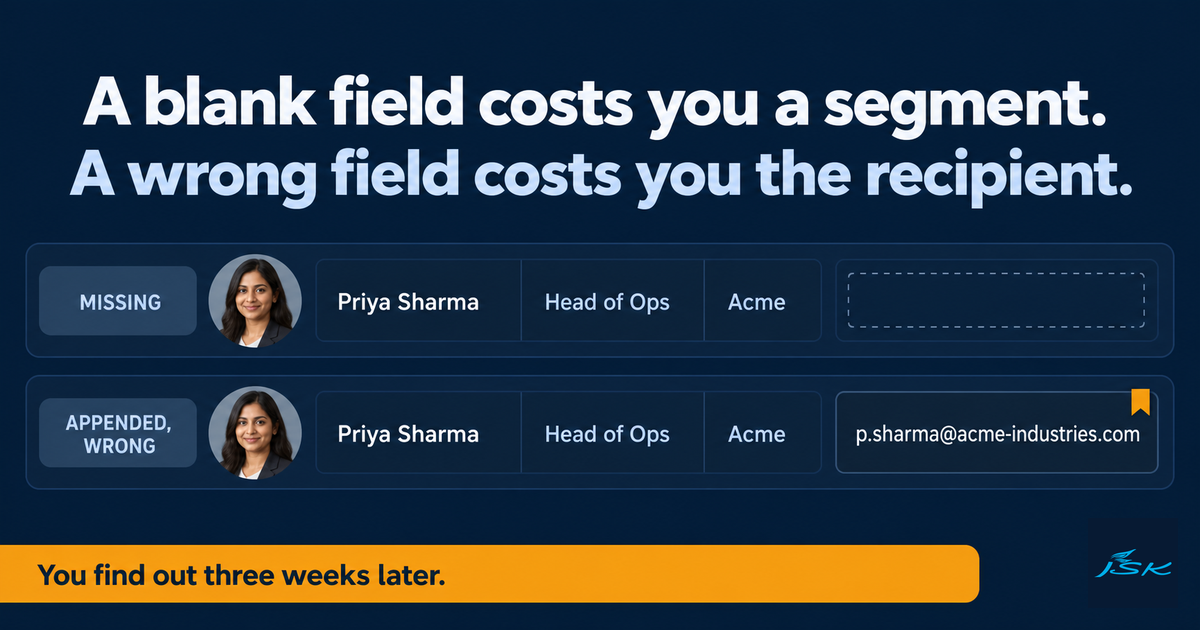
Our own data appending page works through a number we would rather people saw before they buy anything: append 4,000 records, let 6% match to the wrong company, and 240 rows are now attached to an organisation the person does not work for. Nothing looks wrong. The rows are full, the export is clean, the CRM accepts it. With most appended fields you find out weeks later. With an email address, you find out the moment you press send.
That is the whole difference between email appending and every other kind. A wrong job title sits quietly in a column. A wrong email address leaves your building.
What email appending actually does
You hold a record — a name, a company, maybe a phone number — and no way to reach the person by email. Email appending fills that one field from outside sources and hands the record back usable.
It is worth being precise about what that is not. It is not list buying: these are people who already entered your world through a form, an event or a rep. It is not verification, which asks whether an address accepts mail. Appending asks a harder question — whether this address belongs to this person at this company — and the two get sold as one service far more often than they should.
Why a wrong email costs more than a missing one
A blank field costs you a segment. You notice it, you work around it, and the row sits there until someone fills it. The damage is bounded and visible.
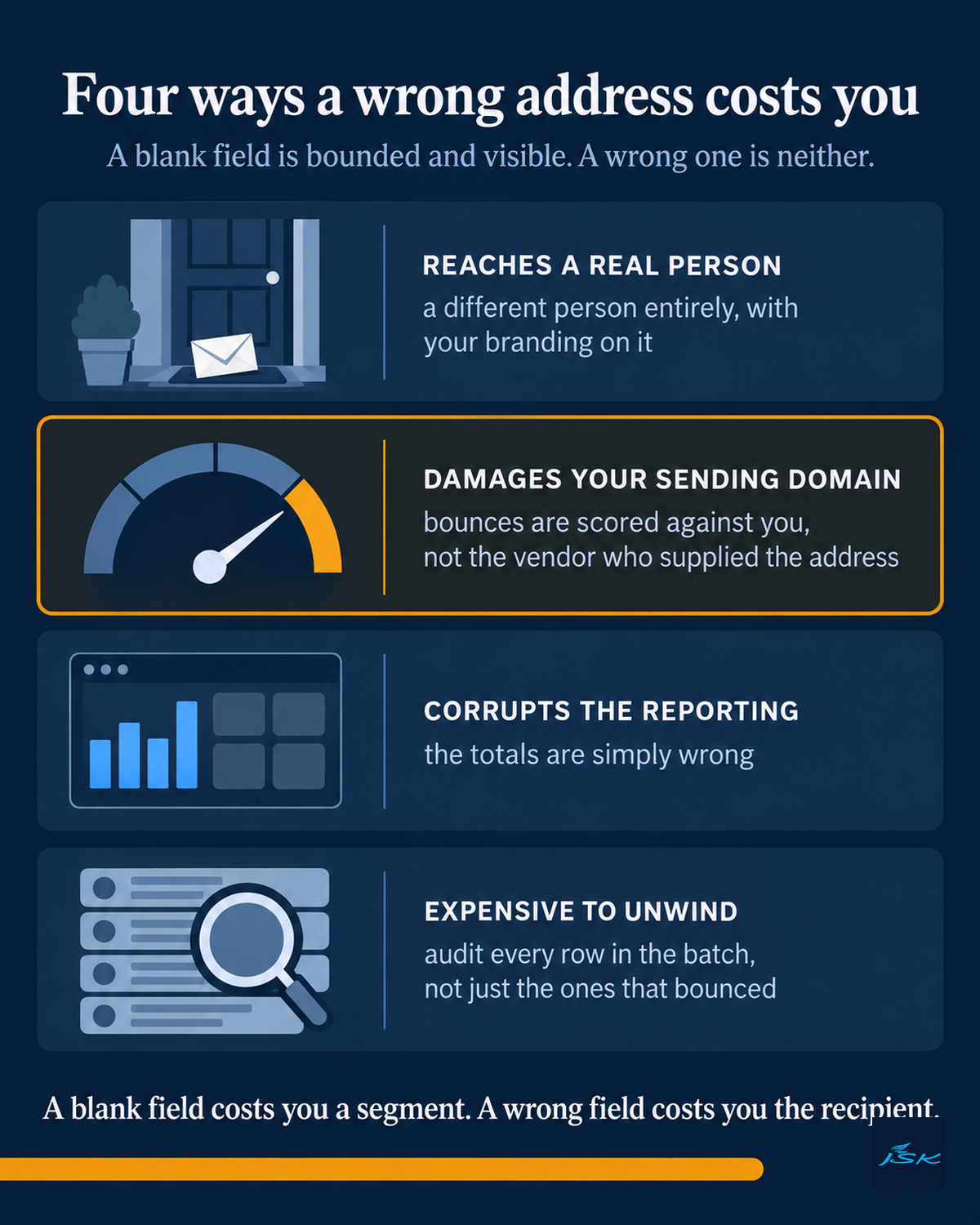
A wrong address is unbounded and invisible, and it fails in four directions at once.
- It reaches a real person. Guessed addresses are rarely dead — they usually belong to somebody. A message intended for a head of operations at one company arrives at a different person entirely, with your branding on it.
- It damages the domain you send from. Bounces and complaints are scored against your sending reputation, not against the vendor who supplied the address. The cost lands on the deliverability of every campaign you run afterwards, including the ones to contacts you had all along.
- It corrupts the reporting. A wrong-company match distorts territory counts and account coverage. The dashboard keeps working, which is the problem — nothing surfaces as an error, the totals are simply wrong.
- It is expensive to unwind. Once appended rows are merged into a CRM and worked by a sequence, separating the good from the guessed means auditing every row that came from that batch, not just the ones that bounced.
This is why we write the match rule down before running anything, and show it to you. What counts as a confident match, what counts as a probable one, and what happens to everything else. A merge you did not agree to is not a fix, and with email addresses it is not a merge you can quietly reverse.
It is also why the low-confidence appends come back labelled rather than blended in. If a record cannot be resolved with confidence, you should be able to see that before it enters a sequence — not infer it afterwards from a bounce report.
The match rate is the wrong number to compare on
The standard advice when choosing between email appending services is to compare match rates. It is the number the category advertises, it is easy to put on a slide, and it is the one metric you should weight least.
The reason is mechanical. Match rate is set by how loose the matching rule is, and a rule can always be loosened. Accept a first-initial-plus-surname pattern at a company domain and the rate climbs immediately, because the pattern is usually right — right often enough to look like skill, wrong often enough to matter at volume. A vendor quoting a high rate has not told you how much of it is inference, and the rate itself cannot tell you.
Two questions are worth more than the headline figure. What proportion of matches were confirmed against a source rather than derived from a pattern? And what happens to the records that could not be resolved — do they come back blank and flagged, or filled with the vendor’s best guess?
Nobody fills 100% of anything, and any vendor quoting a flat completion figure before seeing your data is quoting a sales number rather than a measurement. What drives the real rate is the shape of what you already hold: a record with a company name, a domain and a full personal name is a strong anchor. A record with a personal name and a generic webmail address often cannot be resolved to a company at all — and we would rather leave that blank and say so than attach something plausible.
What this does not solve
An append tells you an address exists and that we believe it belongs to the person on the record. It does not tell you they will read it, and it is not a deliverability service — inbox placement depends on your sending domain, your history and your content, none of which an appended field can influence.
It also does not stay true. Roughly a fifth of B2B contacts change role in a year, which makes appending a cycle rather than a purchase. A database appended once and left alone is a depreciating asset, and email is among the first fields to rot when someone moves.
What it costs, and where to start
Email appending sits inside Data Ops, which starts at $1,200 per month with a first clean-up inside 10 working days. Bounced email replacements within 14 days are not charged extra — if we hand you an address that bounces, replacing it is our cost, not a line on your next invoice. That is deliberate: a vendor who bills for the correction has no reason to tighten the rule.
If you are not sure whether appending is what your list needs — it often is not, and cleaning or enrichment is a different job — the place to start is a 20-minute call. Tell us what is not working. That is the only free entry point we offer, and it is usually enough to establish which of the three jobs you are actually buying.