
Four queries about CRM appending reached this site for the first time last month. One of them, crm contact appending, arrived four times and landed at position 25.8 — page three, which is another way of saying nobody clicked it. We are writing this because the phrasing tells us something: people are not asking how to buy contact data. They are asking what happens when they push it into a CRM that already has records in it.
That is a different problem, and most appending advice skips it entirely.
Appending to a list is easy. Appending to a CRM is not.
If you hand someone a spreadsheet of 4,000 names and ask for job titles back, the job is bounded. Every row is new, nothing collides, and the worst outcome is a blank cell.
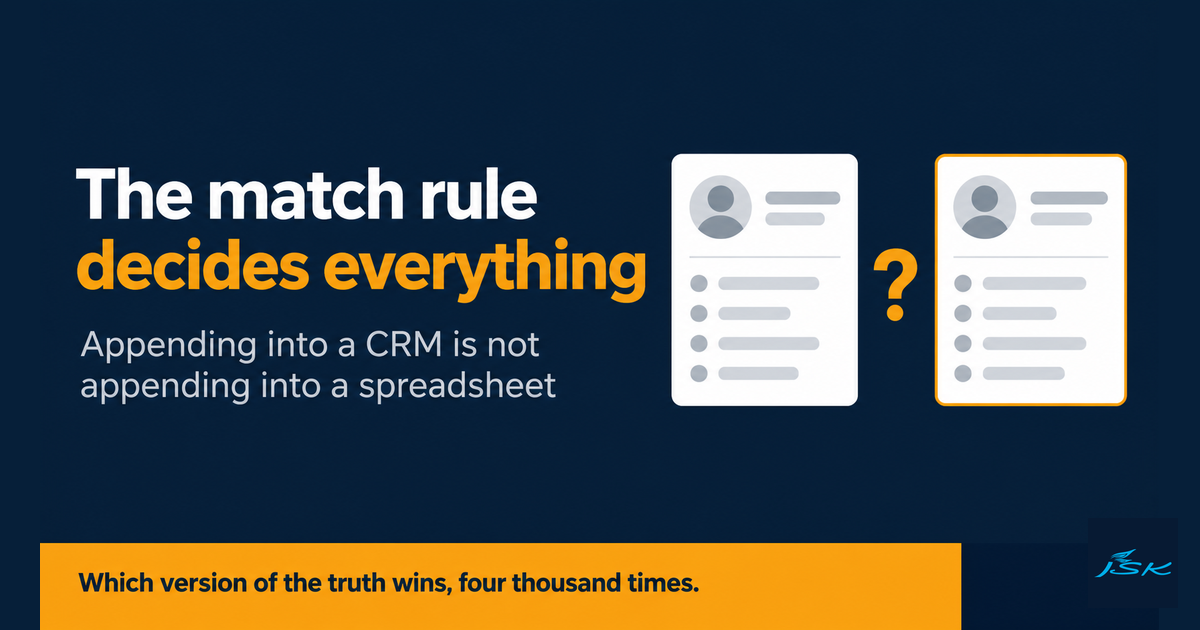
A CRM is not a spreadsheet. It already holds records, those records already have owners, and some of them are already wrong. Appending into it means deciding, four thousand times, which version of the truth wins — and the append is only as good as that decision.
We wrote separately about why appending, enrichment and cleaning are three different jobs. This is the one that sits underneath all three: matching.
The match is the whole job
Before anything can be appended, the supplier has to decide that their record and your record are the same person. Get that wrong and you have not filled a gap — you have written someone else’s phone number into your customer’s file.
Run the arithmetic on a typical job. Append 4,000 CRM contacts at a loose match rule and accept a 6% wrong-company rate: that is 240 records now carrying details belonging to somebody else. They do not look broken. They look complete, which is worse, because completeness is what your team trusts.
This is why match rate is the wrong number to compare vendors on. A higher match rate is trivially easy to produce: loosen the rule. The number that matters is what the rule rejected and why.
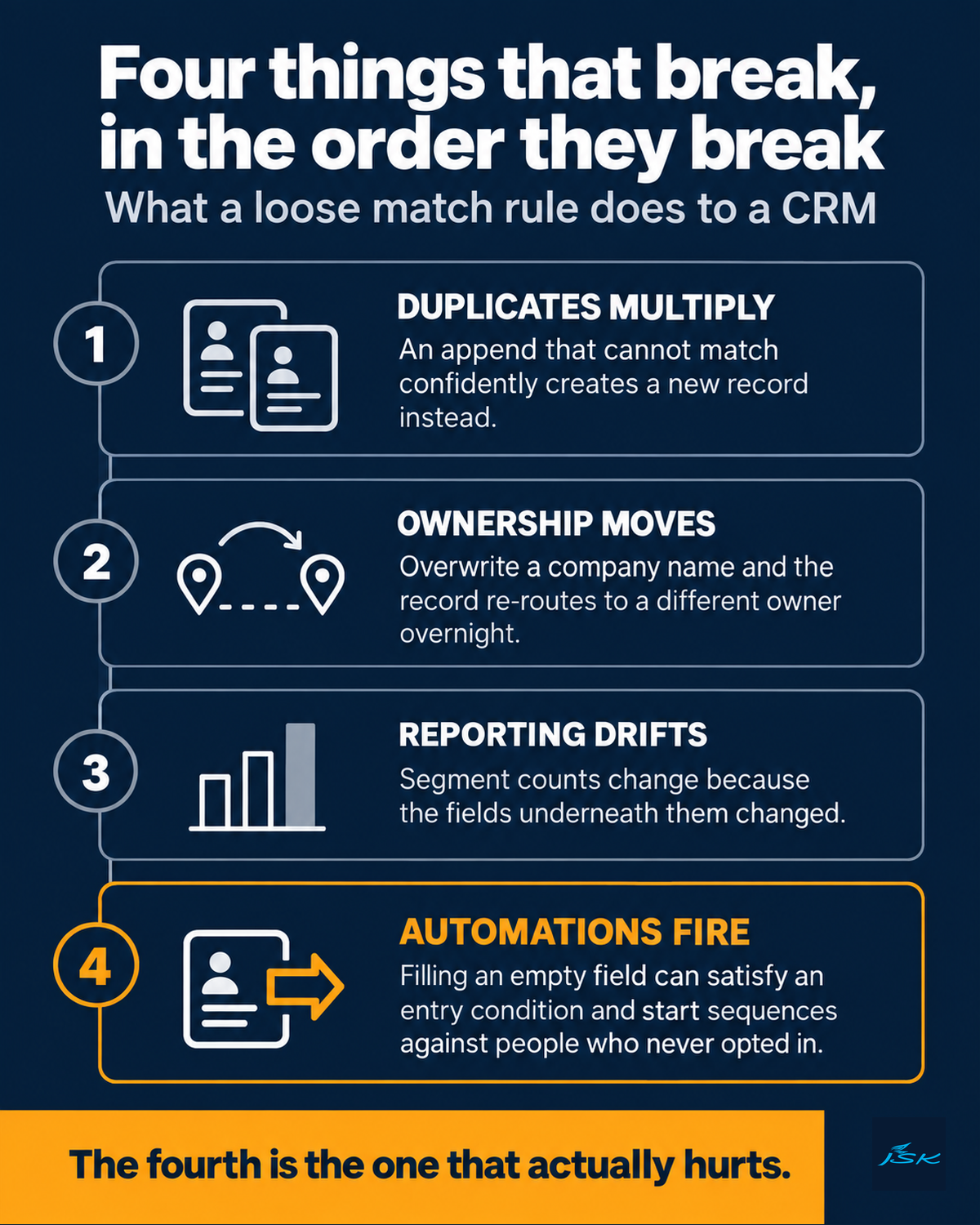
Four things that break, in the order they break
- Duplicates multiply. An append that cannot match confidently often creates a new record instead. You asked for fuller contacts and got more of them.
- Ownership moves. Overwrite a company name and the record can re-route to a different territory or owner overnight. Nobody was told.
- Reporting drifts quietly. Segment counts change because the underlying fields changed, and last quarter’s numbers no longer reconcile with this quarter’s.
- Automations fire. This is the one that actually hurts. Filling a previously empty field can satisfy an entry condition on a workflow and start sequences against people who never opted into them.
The fourth is the reason we ask to see your workflow triggers before an append, not after.
Where the usual advice is wrong
The standard guidance is to back up the CRM first and append everything in one pass. Back it up, certainly. But a full-pass append is the part to refuse.
A restore is not a fix. By the time you know the append was wrong, your team has been working the records for a fortnight, and rolling back destroys their notes along with the bad data. The backup protects the database; it does not protect the work.
Append a sample first, into a staging field rather than over the live one, and check the rejects rather than the matches. The matches are the ones designed to look right.
What this does not solve
Appending cannot tell you whether a contact still works there. It fills the field that was empty at the moment the source was compiled. If your CRM has not been touched in three years, a clean append gives you accurate-looking records of people who left — and no append, however careful, detects that.
It also will not deduplicate for you. Matching for an append and matching for a merge are different thresholds, and running one as if it were the other is how a CRM ends up worse after a data project than before it.
Where to start
Bring the two questions that decide everything: what your match rule is, and what happens to a record that fails it. If a supplier cannot answer the second one, the first does not matter.
Our data appending service starts with a 20-minute call, which is the only free entry point we offer. No sample file, no trial import — because a sample that skips your matching rules tells you nothing about the job you are actually buying.