
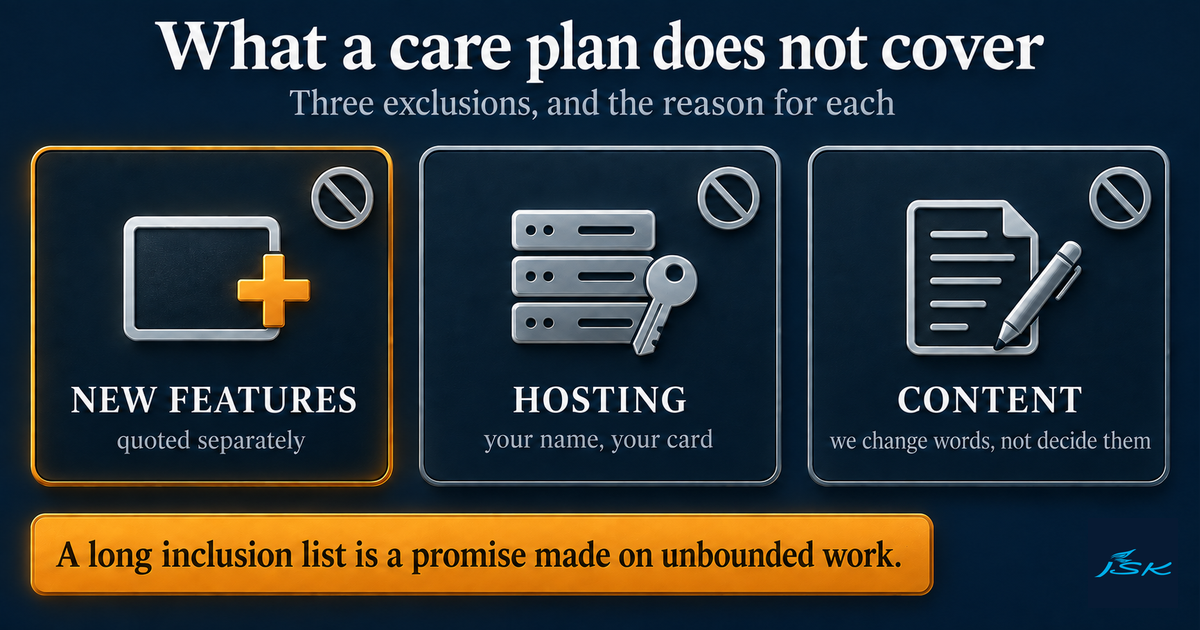
A WordPress care plan is bought on what it covers. It is regretted on what it does not, and that list is almost never on the page you bought from. Ours has three things on it: new feature development, hosting fees, and content writing. This post is about why those three are outside the plan, and why a plan that quietly includes them is worse for you rather than better.
What a care plan is actually for
A WordPress site left alone for two years is not a website. It is an incident waiting for a date. Core, themes and plugins all drift apart from each other, and the first sign of trouble is usually a customer telling you that something is broken.
So the job of a care plan is narrow and boring, and it should be. Updates applied on staging first rather than straight to live. Off-site backups, with a restore tested quarterly, because an untested backup is a hope rather than a backup. Uptime and Core Web Vitals monitoring where the alert comes to us and not to you at 11pm. Vulnerability scanning against a live advisory feed. A monthly report, and a small allowance of content and design changes so you are not quoted for every text edit.
That is the whole product. It is maintenance, and maintenance is worth paying for precisely because it is unglamorous enough that nobody does it themselves.
The three exclusions, and the reason for each
New feature development
This is the exclusion people argue with most, and it is the one that protects you.
A care plan is a fixed monthly fee against unpredictable work. That arithmetic only holds while the work has a ceiling. Maintenance does: there are only so many updates in a month, and a restore either tests clean or it does not. Feature development has no ceiling at all. A booking form becomes a booking form with payments, which becomes a booking form with payments and a cancellation policy.
When a provider folds development into a monthly retainer, one of two things happens. Either the retainer is priced for the worst month and you overpay in every other, or it is priced for the average and the provider starts managing your expectations downward when you ask for something. The second is more common, and you will recognise it as the slow month where nothing you asked for quite got done.
Keeping development out means a change gets quoted, scheduled and delivered as its own piece of work, and the maintenance keeps happening underneath it either way.
Hosting fees
We will work with your host, monitor what it does, and tell you when it is the problem. We will not put it on our invoice.
The reason is ownership. When your agency owns the hosting account, the site is only as portable as the relationship. Leaving involves a migration, a DNS change you cannot make yourself, and a conversation you would rather not have. We have inherited enough of those to be firm about it: the hosting account should be in your name, with your card on it, and you should be able to fire us on a Friday and still have a website on Monday.
It also keeps the monitoring honest. It is easier to tell a client their host is underpowered when we are not the ones billing for it.
Content writing
The change allowance covers changing words. It does not cover deciding what the words should say.
Send us a new paragraph for the services page and it goes up inside the allowance. Ask us to write the services page and that is a different job, done by a different person, and it needs to know things about your business that a maintenance contract has no reason to know.
Plans that include “unlimited content updates” are usually relying on you not using them. It is a line that closes a sale and then has to be managed afterwards, which is a bad trade for both sides.
Where the conventional advice is wrong
The standard guidance when comparing WordPress maintenance services is to look for the plan that includes the most. Count the inclusions, compare the lists, pick the longest one.
That is exactly backwards, and it is backwards for a reason that shows up months later. A long inclusion list on a fixed monthly fee is a promise made against unbounded work. It gets honoured by rationing, and rationing is invisible until the month you need something.
The more useful question to ask a provider is not “what is included?” but “what is explicitly not included, and what happens when I ask for it?” A provider who can answer that immediately has thought about the boundary. One who cannot has not yet had the argument, and you will be the one they have it with.
What this does not solve
A care plan does not make a slow site fast. Monitoring will tell you that Core Web Vitals are failing and roughly where, but the fix is usually a theme decision or an image pipeline, and both of those are development work that sits outside the plan.
It does not undo a bad build either. If the site is carrying six page builders and a decade of abandoned plugins, maintenance keeps it alive without making it good. We would rather say that at the start than discover it together in month four.
And it is not a security guarantee. Scanning against an advisory feed catches known vulnerabilities in things you have installed. It does not catch a zero day, and anyone offering to is selling you something they cannot deliver.
Working out whether you need one
Here is a test you can run in about a minute, without talking to anyone.
Open your WordPress admin and look at the updates screen. Count how many plugins are waiting. Then find the date of your last backup, and answer a harder question about it: has anyone ever restored from one? Not “is the backup running” but “has the restore been tested”. If you cannot answer the second question, you do not have backups. You have files that are probably backups.
If that count is in double figures, or the restore has never been tested, a plan is worth the money. If you patch monthly and you tested a restore this quarter, it is not, and you should keep doing what you are doing.
Our plan starts from $180/month, and the exclusions above are the same three on the WordPress care plan page. If you want to talk it through first, a 20-minute call is the only thing we offer for free, and it is genuinely the first door rather than a sales step with a different name.